

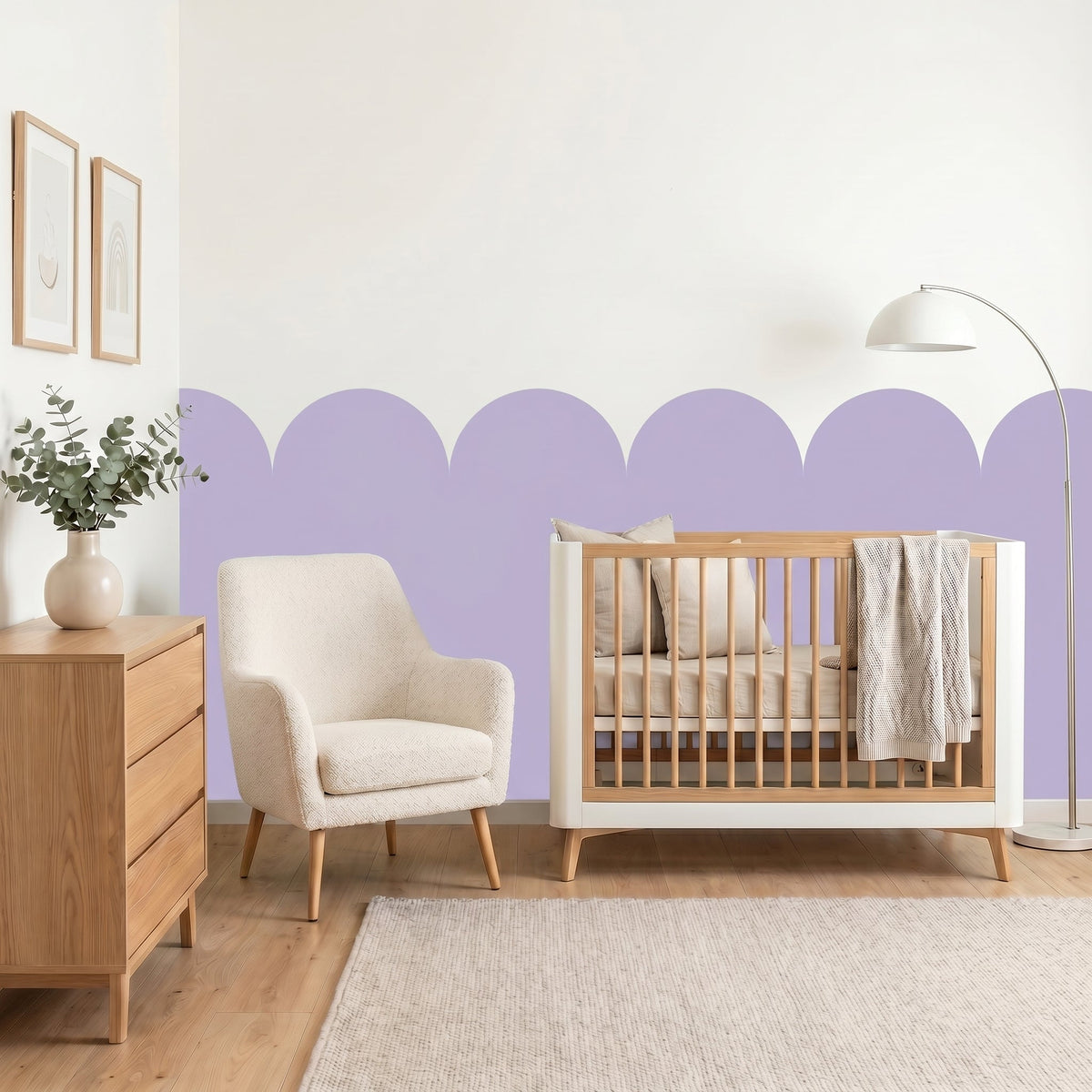
The nursery trend moving fastest right now is shape rather than motif: a stripe or a scalloped edge finishing at half wall height, in softened lilac, powder blue or yellow-green. It reads as architecture instead of decoration, which is why it does not start to look babyish by the time she is six. Block-colour fabric panels build it for about A$200 a wall, with no paint and no tools.
Something has shifted in the nursery photos coming through this year. The wall is still the first thing people notice, but it is no longer a tree, an animal or a name in cursive. It is a shape: a wide stripe up to dado height, scallops just above the cot, a wave line around the room.
What is actually moving, and how we know
Three sources point the same way, which is our test before calling anything a trend.
Pinterest published its 2026 predictions under the heading FunHaus: circus interior up 130 per cent, circus nursery up 50 per cent, striped ceiling up 40 per cent. It names the nursery directly, which Pinterest rarely does.
Dulux released its 2027 Colour Forecast for Australian homes in early September 2026. Three palettes: Play, built on muted lilac and powder blue; Sensory, warm soft neutrals; Treasure, jewel tones. Lauren Treloar, Dulux Colour and Design Manager, tied them together: "a return to softened yellow-greens and blues with grey and purple undertones that captivate our collective longing for grounding."
Overseas, Apartment Therapy has named stripe drenching a leading 2026 trend, calling the look "circus chic".

Then there is our own store. Over the last ninety days our scallop panels came tenth by revenue and the wide stripe panels sixteenth, and three of the last month's fifteen best sellers were geometry rather than motif: a sage stripe, a blue ric rac, a colourful checker. Shape is not replacing the gum trees and koalas. It is arriving next to them.
Why the literal circus version will not last
Here is the part the trend reports leave out. The full treatment, primary red and yellow, big top stripes at full wall height, is a costume, and costumes date. Worse, it dates the way a mural does: a parent commissions something specific, and the child grows into a person who did not choose it.
Worth knowing: the most common regret people share about hand-painted nursery murals is not the cost. It is that the child stopped liking it, or new furniture made the composition awkward, and undoing it means repainting the room.
The durable version comes down to two decisions: keep the shape simple, and keep it low. A stripe or scallop stopping at roughly 120cm reads as panelling, which is to say it reads as part of the house. Architecture does not become babyish. A cartoon does. That matches what customers ask us for in their own words: "something that will grow with her".
The palette: three ways in
Softened lilac
Lilac has been the nervous colour in nurseries for a decade, because most lilacs go sweet fast. The version arriving now has grey in it, which stops it reading as sugar. Our Lilac, Lavender and Orchid all sit in that muted band.


Powder blue, without the nautical detour
Powder blue behaves well in Australian light. It holds up in a bright north-facing room where a stronger blue goes cold, and against warm timber it stops short of sailboat-and-anchor territory.


Yellow-green, the grounding one
The softened yellow-greens are the least obvious and the most useful, because they read as a neutral on the wall. Pistachio, Sage and Moss fall here. Choose this group if you want the shape to be the feature and the colour to disappear.


The wall, three ways
All three are made the way our hand-painted fabric wall decals are made: printed on fabric rather than PVC vinyl, in Melbourne, matte and with no sheen. That is why people keep assuming the wall was painted.
Scallops, for a soft edge
Block-colour scalloped panels, each 50cm wide and 120cm high, side by side without overlap. Twenty-seven colours, A$50 a panel. A 2m cot wall is four panels at A$200.
Wide stripe, for the panelling look
Wide vertical stripes with a scalloped top edge, same 50cm by 120cm panel, same A$50, twenty-eight colours. This is the one that reads most like custom joinery.
Wave trims, for the smallest commitment
A single soft wave of colour, 120cm long, in three heights: 10cm at A$14, 15cm at A$19, 30cm at A$39. Run it at skirting level, at cot height, or around a doorway. If you are unsure, start here.

What goes with it, from other Australian makers
None of these are ours and none of them paid to be here. Prices checked 30 September 2026.
The cot
The Mocka Dream Cot in Almond and Natural, A$269.99. Two-tone pine keeps the timber warm, which stops lilac or powder blue tipping cold.
The bedding
Kip&Co's Limoncello Stripe organic cotton baby fitted sheet, A$35 bassinet and A$55 cot. A lemon stripe on the bed against a quieter stripe on the wall is the mix this trend is really about.
The cushion
The Pink Stripe lumbar cushion from Castle and Things, A$79 for the cover or A$109 with an Australian-made insert. Hand-printed velvet, for the feeding chair.
The paint above the panel
Bauwerk Colour's Lilac limewash, A$49.50 a litre, made in Western Australia. They call it a soft mauve with a slight grey undertone, which is exactly where this colour has landed.
The light
A Blossom Green lampshade from Bowerbird Collections, from A$280, handmade in their Brisbane studio. The dearest thing here, and the one that will outlive the nursery.
How to use this in your own room
Measure the wall width in centimetres and divide by 50. That is your panel count, rounded up: a 2m cot wall is four, a 3.5m double bed wall is seven. Order the whole wall in one go, because block colours print in batches and colour can shift slightly between them.
Fabric panels are easiest on fresh, clean paint that is not chalky, so wipe the wall down and let it dry. Put one piece up and leave it 48 hours before committing to the whole wall, and aim to have them up within about three months of delivery. Panels sit side by side without overlap, so line each one up against the last.
For cost context: a painter for one bedroom, walls only, runs A$500 to A$900, with an Airtasker median of A$920. A Melbourne hand-painted nursery mural runs A$3,250 to A$5,850, according to Book An Artist. A four-panel scallop wall at A$200 clears our free shipping threshold of A$150.
Like they've been painted on.
Judge.me review
Peel & Stick Wall ScallopsTiny Walls, A$50 per panel
Half Wall Panels, Wide StripeTiny Walls, A$50 per panel
Wave Wall TrimsTiny Walls, from A$14 per panel
Frequently asked questions
Will stripes and scallops date as fast as a themed nursery?
A simple shape in a muted colour at half wall height reads as panelling, and panelling has been in Australian houses for a century. The version that dates is the literal one: big top stripes at full wall height.
What height should a half wall stripe or scallop finish at?
Our panels are 120cm high, just above a cot rail and roughly where a dado sits. Going higher starts to read as wallpaper, and the architectural effect is what makes the look last.
How many panels do I need for one wall?
Measure the wall in centimetres and divide by 50, rounding up. A 2m wall is four panels, a 4m wall is eight. A cot feature wall is usually three or four.
Does soft lilac work in a small nursery?
It does, better than a stronger colour, because the grey in it keeps it from bouncing light around. Keeping it to the bottom 120cm leaves the ceiling line light, which helps.
Can I put panels on a textured or freshly painted wall?
They are easiest on fresh, clean paint that is not chalky, and on a smooth surface. If your wall is textured or was painted long ago, put one piece up and leave it 48 hours first.
Do the scallops, stripes and wave trims come in the same colours?
Very nearly. Scallops come in twenty-seven colours, wide stripe panels in twenty-eight, and the wave trims share the same colour card, so a trim can match your panels.


